Specifications
Community build: 16-channel logic probe for Rigol MSO5000 and DHO900
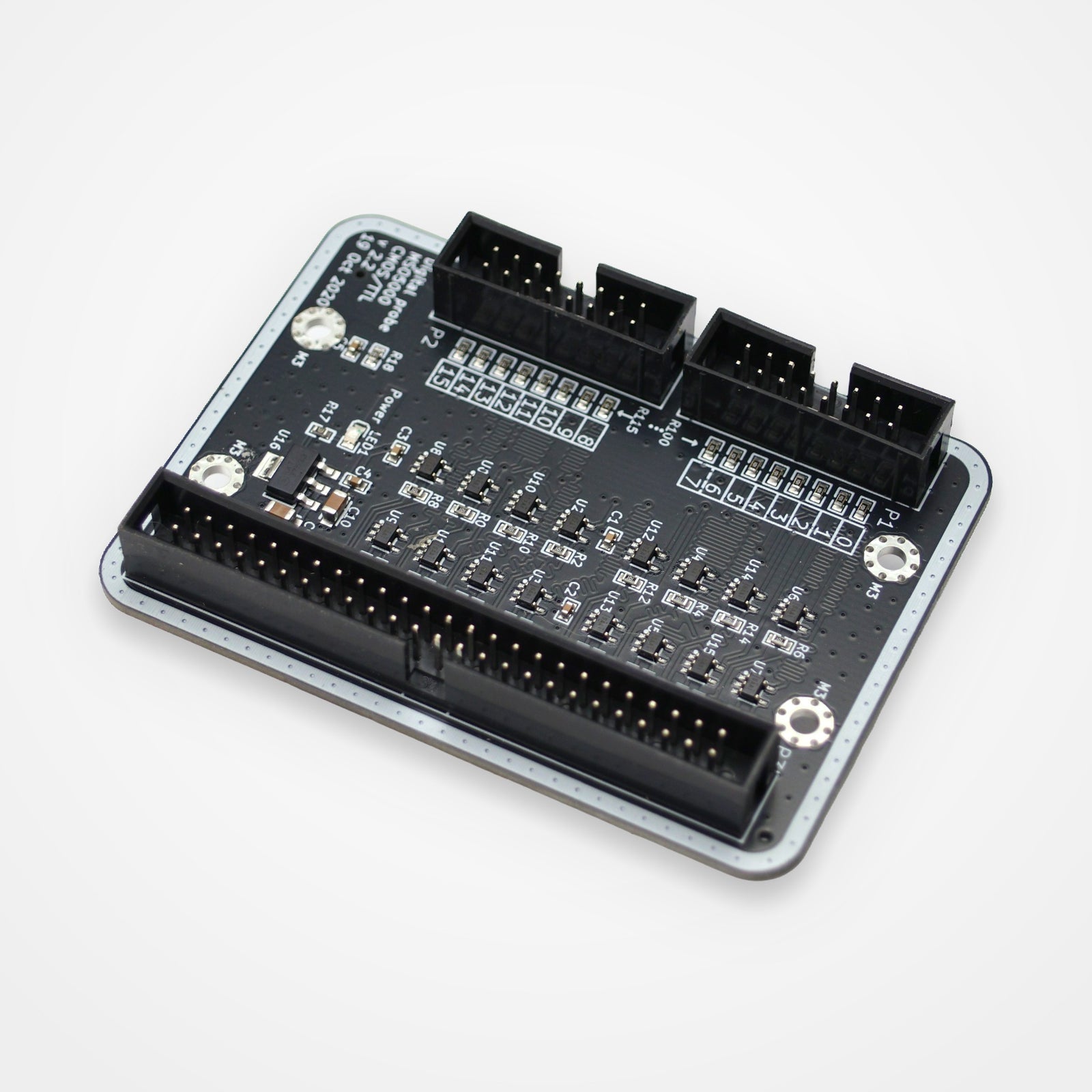
This is a hand-assembled build of the open-source Logic Probe 16. The probe converts 16 single-ended digital signals (D0–D15) to LVDS pairs over the 50-pin connector on the scope. Your scope then sees a full digital-channel set and decodes SPI, I²C, UART, and parallel buses with its own built-in decoders.
This is not our original design. S. Petrukhin (EasyEDA user f33net) designed the circuit in 2020. hydrabus contributed the v2.2 KiCad port and the matched-length traces in October 2020. Gandalf_Sr reverse-engineered the 50-pin connector pinout on the EEVblog forums. The EEVblog community tested and validated the design across several MSO5000 models.
We assemble, test, and ship it for people who want a working probe without sourcing parts and soldering more than 50 components. The price covers parts, assembly labor, testing, and shipping.
You can build your own instead. Every source file is public:
- Circuit and BOM: OSHWLab project (Petrukhin)
- Community discussion: EEVblog thread
- 3D-printable enclosures: Thingiverse (DamianB2)
What we do
- Source genuine parts. TI SN65LVDS1 LVDS drivers and an ON Semi MC33375 LDO. These are documented parts with published datasheets.
- Assemble the board. We solder every component to the v2.2 PCB.
- Test every channel. We verify all 16 channels individually for correct LVDS output before shipment. We confirm the power LED.
- Enclose it, if you select that option. A 3D-printed case with M3 standoffs and connector cutouts. The STL files are public if you prefer to print your own.
- Ship from the USA. Orders leave within 2 business days with USPS tracking.
- Answer questions. Contact us if the probe does not work with your scope. We reply during the business week.
Configurations
| Option | What you receive |
|---|---|
| Bare PCB | Unpopulated 2-layer board. Full BOM with LCSC, Mouser, and DigiKey part numbers. Links to the EasyEDA and KiCad source files. You solder it yourself. |
| Assembled Board | Fully soldered board with genuine TI and ON Semi parts. All 16 channels tested. No case. |
| Complete kit | Assembled and tested board mounted in a 3D-printed case with M3 standoffs and connector cutouts. |
No cable or clips are included with any option. You need a 50-pin IDC ribbon cable and probe wires or clips to connect the probe to your circuit. These parts are widely available and inexpensive. Contact us if you want help sourcing them.
Specifications
| Channels | 16 (D0–D15), single-ended |
| Input connectors | P1 (D0–D7) and P2 (D8–D15), 2×8 pin headers, 2.54 mm pitch |
| Input voltage | 0–5 V, per the TI SN65LVDS1 datasheet |
| Switching threshold | ~1.4 V fixed, TTL level. The scope cannot adjust it. |
| Driver IC | TI SN65LVDS1 ×16, SOT-23-5, one per channel, up to 400 Mbps |
| LVDS termination | 100 Ω per channel |
| Input protection | Series resistors on every channel |
| Regulator | ON Semi MC33375ST-3.3T3G LDO, 260 mV dropout, 300 mA |
| Power | Scope-powered through the 50-pin connector, about 86 mA total |
| PCB | 2-layer, about 60×80 mm, matched-length traces (v2.2), four M3 holes |
| Indicator | Power LED |
| Decoders | Works with the MSO5000 built-in SPI, I²C, UART, and parallel bus decoders |
| Tested to | 160 MHz, community verified on EEVblog. 50 MHz by the original author. |
Scope compatibility
| Scope | Status |
|---|---|
| MSO5072 / 5074 / 5102 / 5104 / 5204 / 5354 | Confirmed by the EEVblog community |
| DHO914 / DHO914S / DHO924 / DHO924S | Same connector. Users report it works. We have not verified it ourselves. |
| MSO1000Z series | Not compatible. The pinout differs. |
Limitations
Read this section before you order. These limits are inherent to the design.
- Fixed ~1.4 V threshold. The probe is reliable for 3.3 V and 5 V logic. It is not reliable for 1.8 V logic. The threshold setting on your scope has no effect on this type of probe.
- Single-ended inputs only. CAN, RS-485, and other differential signals need an external transceiver.
- 0–5 V input range. Do not exceed 5 V. Do not go below 0 V.
- 2-layer PCB. This is adequate for typical embedded work. It is not impedance-controlled like a 4-layer design.
- No cable or clips. Source the 50-pin IDC cable and clips separately.
How this compares to other MSO5000 probe options
Several probes cover 16 channels on the MSO5000. Here is an honest comparison. Prices are approximate street prices from mid-2026. Check current prices before you decide.
| Rigol PLA2216 (OEM) | Import clones | DIY build | This build | |
|---|---|---|---|---|
| Price | ~$399 | $80–$96 | ~$15–$20 BOM plus your labor | $30–$160 |
| Signal IC | LMH7322 dual comparator ×8 | SN65LVDS391 quad driver ×4 | SN65LVDS391 quad driver ×4 | TI SN65LVDS1 single driver ×16 |
| Threshold | Adjustable from the scope | Fixed ~1.4 V | Fixed ~1.4 V | Fixed ~1.4 V |
| Max input | ±40 V | 5 V | 5 V | 5 V |
| Schematic | Proprietary | Not provided | Open source (KiCad) | Open source (EasyEDA and KiCad) |
| If one channel fails | Return it to Rigol | Lose 4 channels per failed IC | Lose 4 channels per failed IC | Replace one SOT-23 part |
| Testing | Factory tested | Unknown | You test it | Every channel before shipment |
| Ships from | US distributor | China, 2–4 weeks | JLCPCB, 1–3 weeks | USA, 2–3 days |
Buy the Rigol PLA2216 instead in three cases. You work with 1.8 V logic. You run mixed-voltage systems. You measure signals above 5 V. Those cases need an adjustable threshold and a wider input range. The PLA2216 uses LMH7322 comparators that read the reference voltage from the scope. No LVDS driver probe can do that, including this one. For 3.3 V and 5 V embedded work, LVDS driver probes work well.
Credits and source files
This probe exists because of the following people and their open contributions:
- S. Petrukhin (f33net) — original circuit design, v2.0 and v2.1. OSHWLab
- hydrabus — KiCad v2.2 port, matched-length traces, and JLCPCB assembly files, October 2020.
- Gandalf_Sr — MSO5000 50-pin connector pinout, published on EEVblog.
- The EEVblog community — testing, bug reports, and validation. Forum thread
- Enclosure designs — DamianB2 and khomerik on Thingiverse, Edward Lai on Printables.
All design credit belongs to the original authors. We build, test, and ship as a service. If you have the skills and the equipment, we encourage you to build your own from the files above.
Assembly and shipping
We assemble, test, and ship this probe from Pittsboro, North Carolina. Orders leave within 2 business days with USPS tracking. Returns are accepted for 30 days.

